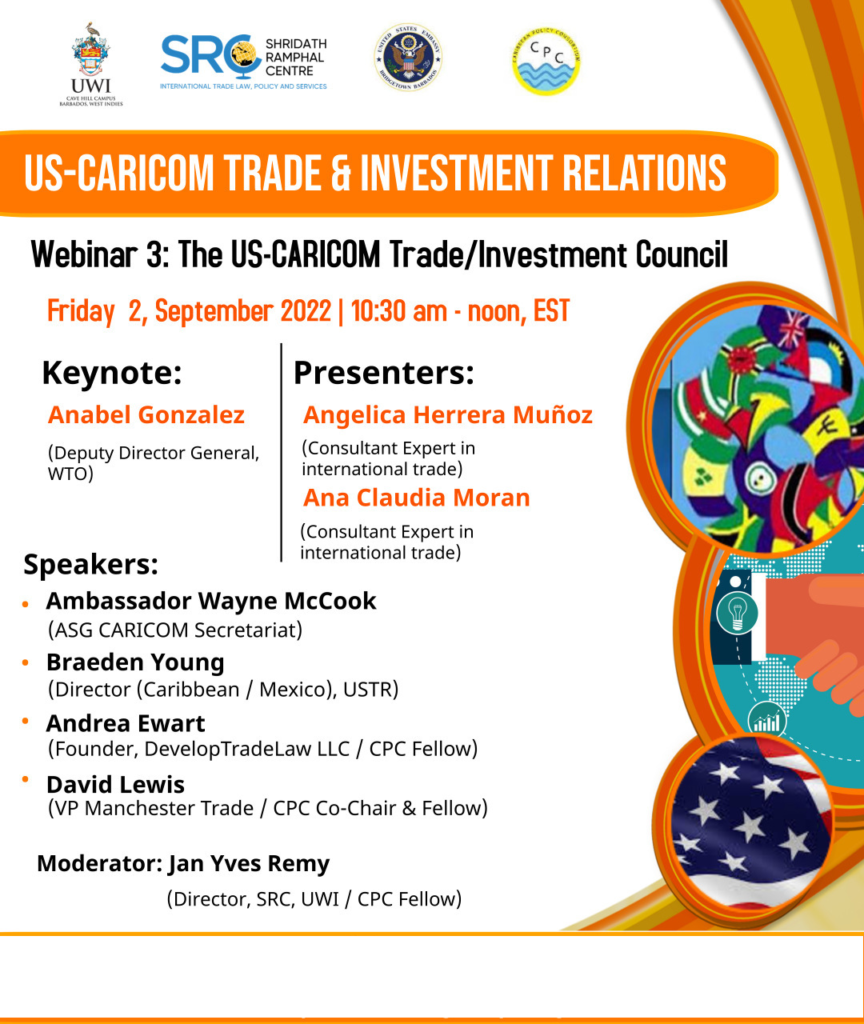
This webinar explores how the US-CARICOM Trade and Investment Council (TIC) under the Trade and Investment Framework Agreement (TIFA) of 2013 can be used to promote more focused negotiations between the U.S. and CARICOM. Special focus on the US-Uruguay TIC (2008) as a best practice benchmarking experience with its five times increase in bilateral trade and two times increase in US FDI into Uruguay between 2008-2016 and into the present.
How should Guyana leverage oil and gas revenues to produce a world-class twenty-first-century education system at all levels, focusing on broad coverage of the country and with strong links to the best institutions of higher learning abroad while fostering local skills in key local content areas?
Executive Summary
Education and innovations pertinent to industry needs are vital to national development. State leaders must be deliberate in privileging human capital investments, given their connectedness to sustainable economic growth. The education sector and innovations therein are particularly salient for Guyana and the Caribbean as the nation now occupies a seat around the global table of leading oil producers
Panelists
Dr. Cardinal Warde, considered one of the world’s leading experts on materials, devices, and systems for optical information processing, is a professor of electrical engineering at MIT. Professor Warde is the Executive Director of Caribbean Science Foundation (http://caribbeanscience.org/) CARICOM Research Building UWI Cave Hill Campus, Bridgetown, Barbados.
Prof. Edward Greene, former UN Special Envoy and CARICOM Deputy Secretary General, Chancellor of the University of Guyana.
Prof. Paloma Mohamed, Ph.D., MS AA, eleventh Vice Chancellor of the University of Guyana. She is a full Professor of behavior and communications and is noted as a futurist scholar for her work on change in both humans and human systems. She is the first woman to lead the University in its 58-year history and the first to be appointed Vice-Chancellor at any University in the Anglophone Caribbean.
Dr. Leyland Lucas, Dean, School of Entrepreneurship & Business Innovation at the University of Guyana.
Moderators
Dr. Terrence Blackman, Medgar Evers College at the City University of New York, Guyana Business Journal
Dr. David E. Lewis, Caribbean Policy Consortium & Manchester Trade Ltd. Inc.
Key Quotes
Dr. Paloma Mohamed Martin (Vice Chancellor of the University of Guyana)
“The process of building a technically competent workforce cannot be successful if it is done in isolation from the education systems… The education and training infrastructure must therefore be developed as a true partnership… with the local universities, training institutions, and technical vocational institutes as well as operators and their service providers.”
“We have to scale up. We cannot keep up with the demand for instance for engineers, persons in computing and so on. We are getting huge demand for support services, so international affairs, languages, economics, finance… that support these industries (oil and gas).”
“The human infrastructure of a country is what will sustain a country and what will ensure sustainability.”
Dr. Edward Greene (Chancellor of the University of Guyana)
“One of the most striking paradoxes that we have to take into consideration as we move ahead is the resource curse, of which Guyana must be mindful. Countries rich in nonrenewable natural resources, such as oil and minerals, have experienced according to the overall analysis, slower economic growth than resource poor countries… Our emphasis should be placed on the wider issues of human development… more particularly on human capital development.”
“We must take education as an investment in human development.”
Dr. Leyland Lucas (Dean, School of Entrepreneurship and Business Innovation)
“We need to move away from this obsession with growth and focus on development… Development is what will take this country forward and education is part of the conversation about development.”
Dr. Cardinal Warde (Executive Director of the Caribbean Science Foundation)
“The government needs to get the people involved and get the people to be passionate about the new direction and science and technology and where it can take Guyana.”
“Oil and gas will one day be gone… but I think we will be using fossil fuels for a while… Using the resources that you have to diversify your economy now, and yes, we all agree, education is the key and developing the work force for the future is key towards diversifying the economy.”
The presentation, by Rystad’s Head of Latin America, Schreiner Parker, explores recent developments in Guyana’s oil and gas industry. Parker reports on what has been done so far in governance and identifies what still needs to be implemented to maximize Guyana’s benefits. The report examines how Guyana’s oil and gas industry can compete in a world transitioning from fossil fuels; Guyana’s exploration success and future developments; the long-term sustainability of Guyana’s deepwater oil & gas; value creation for government and companies; and Guyana’s governance of natural resources and its development.
EXECUTIVE SUMMARY
(i) Government Take
The report finds that 2022 is a landmark year for Guyana – with government revenues from oil production forecasted to potentially reach as high as US $1.5 Bn and an average of $3.6 Bn per annum through 2030 (and $12.4 Bn annually between 2031 and 2040). Rystad forecasts the government take to peak at $16 Bn per year in 2036. Cumulatively, this amounts to roughly $157 Bn in government take for Guyana by 2040.
Guyana’s government take (including royalties and profit sharing) is competitive with other frontier and non-frontier regions with an overall take of 59%, including profit sharing and royalties, compared to 47% in Suriname. Guyana also ranked higher than the peer group average of 54%.
(ii) Emissions & the Energy Transition
The emissions intensity of Guyana’s production is nine kgCO2/boe–half of the global average and able to outperform ~75% of global producing assets. This is due to several factors, including larger-scale developments with fewer wells with high rates of productivity, more specialized technical solutions to limit emissions, such as gas reinjection, and more stringent regulations.
Guyana offshore is also one of the most resilient segments under carbon tax scenarios. With taxes of US$50 per tonne, US$100 per tonne, and US$200 per tonne, Guyana’s average breakeven remains resilient due to lower relative carbon intensity compared to other sources.
(iii) Role in Global Discoveries
Guyana has led in offshore discoveries since 2015 with 11.2 billion boe, accounting for 18% of discovered resources and 32% of discovered oil.
Guyana has accounted for 18 of the top 30 largest offshore oil discoveriesglobally since 2015.
Guyana is one of the most competitive supply sources outside of core Middle East and offshore Norway production, beating out the Permian, Russia, and many other offshore sources under various commodity price scenarios, with an overall liquid breakeven of $28.0/bbl. (including future developments)
(iv) Governance
Rystad expects substantial improvements in transparency as new legislation comes into effect. The country is implementing new governance mechanisms and institutions based on global standards and best practices to manage its natural resource wealth, including passage of NRF Act 2019 and amendment in 2021 and passage of Local Content Act 2021 and operationalizing of the Local Content Secretariat, but more remains to be done.
Schreiner Parker, Senior Vice President & Head of Latin America, Rystad Energy
Key Quotes
“Guyana’s emissions intensity is only half of the global average…Guyana’s emission intensity for producing assets actually outperforms almost 75% of global performing assets. This is significant and very important in terms of being part of that supply source in the long term.”
“If we fast forward to 2035, Guyana becomes the fourth largest offshore oil producer in the world at 1.7 million barrels per day of production outpacing traditional offshore provinces like Norway, the United States, the United Kingdom and Mexico.”
“Guyana will go from a frontier exploration player to a top five global exploration producer in the next five years.”
“Guyana is very well positioned in the government take aspect and actually higher at 59% than the average for the peer group being 54%… The Guyana government take, which we estimate will reach $7.5 billion per year by 2030, and again that $157 billion by 2040 cumulative. It is important to note that in these estimates we are only talking about the Stabroek Block.”
“Guyana has an oil industry that is sort of less than ten years old and yet it is scoring materially higher than Mexico, who has an oil and gas industry that is more than 100 years old. So I think what we can really show here is that Guyana is taking the right steps to ensure that good governance is a staple of the development of the oil and gas industry and that the benefits of this resource will go to the Guyanese population who are, at the end of the day, the rightful owners of this resource.”
Joel Bhagwandin,Director Corporate Finance Advisory | SPHEREX Analytics SPHEREX Professional Services Inc.
KEY QUOTES
“The story is essentially the same, which is the government essentially will earn more in terms of profit and royalties versus the oil companies (regardless of approach between looking at all of Stabroek Block or just the four approved projects).”
“In the area of transparency I would say, in the circumstance given our situation, we are doing fairly well. The production sharing agreement is a public document, the production sharing agreements of other exploration that are ongoing with other companies are public documents.”
Arthur Deakin, Energy Practice Co-Director, American Market Intelligence
Key Quotes
“If it (associated gas) is 20% of the 11 billion barrels of oil equivalent that have been discovered that would equal, more or less by our calculations, 13.2 billion cubic feet of associated gas which would make Guyana have the third largest gas reserves in Latin America, behind Venezuela and Argentina.”
“These (infrastructure) projects have been part of the plan for many decades, but now that Guyana actually has the money, or has the money coming in, it’s really time to implement it.”
MODERATORS
Terrence Blackman
Founder, Guyana Business Journal
David Lewis
Vice President, Manchester Trade Ltd. Inc. & Co-Chair and Fellow, Caribbean Policy Consortium
Who we are
THE GUYANA BUSINESS JOURNAL & THE CARIBBEAN POLICY CONSORTIUM are dedicated to exploring and understanding the Guyanese and Caribbean economy’s key issues and developing concrete policy proposals supporting the region’s socio-economic and political development.
(i) Bring together experts and prominent voices from Guyana, the diaspora, and around the world to discuss the impacts of Guyana’s oil and gas development;
(ii) Offer a nuanced look at the opportunities and potential pitfalls ahead for Guyana;
(iii) Explore strategies to maximize the positive impacts of the oil revenues on Guyana’s people and her future while mitigating the risks that other countries have faced; and
(iv) Identify the most promising roles the Diaspora can play in this transformation.
In Episode II, the panel focuses on balancing the exploitation oil and gas resources and protecting the environment.
THE GUYANA BUSINESS JOURNAL & THE CARIBBEAN POLICY CONSORTIUM are dedicated to exploring and understanding the Guyanese and Caribbean economy’s key issues and developing concrete policy proposals in support of the region’s socio-economic and political development.
SPEAKERS
Kemraj Parsram, Executive Director of Guyana’s Environmental Protection Agency (EPA). A graduate of the University of Guyana with a Diploma in Forestry (1992-1994), and Bachelor of Science, Environmental Studies (1994-1998), he also graduated with a Master of Science in Natural Resources Management (2001-2003) from the University of the West Indies, Cave Hill Campus. He has pursued academic research and field studies at the Doctoral level in Marine Resources Governance (2008-2013) at the University of the West Indies, Barbados. More recently (2018), he received a Post Graduate Diploma in Environmental Law and Policy from the University of New Delhi. He is an expert in the fields of environmental and natural resources management, law, policy, and governance in the wider Caribbean.
Dax Driver, President and CEO of The Energy Chamber of Trinidad and Tobago. Dr. Driver has been the chief executive of of The Energy Chamber for more than two decades. During his tenure he has overseen the complete transformation of the organization into an extremely well respected and recognized Chamber, with a reach across the entire Caribbean region. He has extensive knowledge of the energy industry and the policy issues impacting the sector, especially in small island and middle-income economies, and the impact of industry on the economy, society and the environment. His is a strong but unusual academic background for somebody in his position. He holds a PHD from the University of London in environmental history of Southern Africa. He is passionate about bringing value to the member companies of the Energy Chamber and especially in helping them navigate the challenging environment and the uncertainties brought about by the energy transition.
Lorraine Sobers, Fulbright Scholar and Lecturer at the University of the West Indies, St. Augustine. Dr. Sobers has a BS in Chemical Engineering and postgraduate degrees, MS and Ph.D. in Petroleum Engineering. She has 19 years of experience in the energy sector and specializes in geologic storage of carbon dioxide. Dr. Sobers is the Project Coordinator for the Carbon Dioxide Emission Reduction Mobilization (CERM) Project and a Fellow of the Caribbean Policy Consortium,
Neville Trotz, Dr. Trotz served as Dean, Faculty of Natural Sciences at the University of Guyana and Director of the Institute of Applied Science and Technology at Turkeyen, Guyana, before becoming Science Adviser to the Commonwealth Secretary-General (1991-1997). Most recently he served as Science Adviser to the Caribbean Community Climate Change Centre, based in Belmopan, Belize.
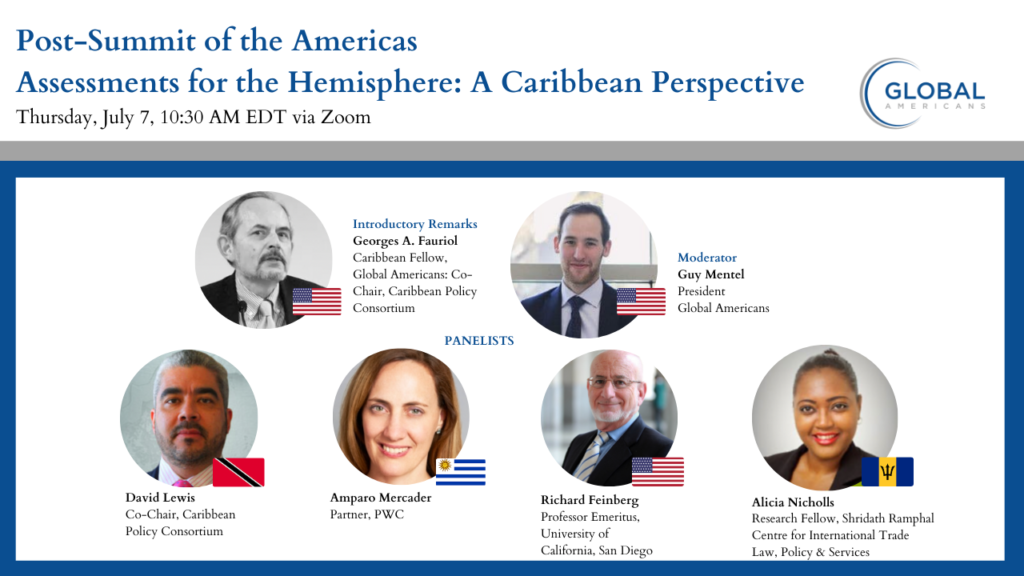
The Global Americans and the Caribbean Policy Consortium hosted a conversation with Georges Fauriol, David Lewis, Amparo Mercader, Richard Feinber, and Alicia Nicholls. Panelists assessed the IX Summit of the Americas from a regional perspective and compared this summit to summits past. Georges A. Fauriol offered opening remarks, and Guy Mentel moderated the conversation. See full video below.
Summary
Georges Fauriol began the event with an opening presentation, summarizing the outcomes of the Summit of the Americas, held last month in Los Angeles. Even before the summit took place, it had already generated controversy among regional leaders due to the exclusion of Cuba, Nicaragua, and Venezuela. Several of the initiatives launched at the summit—including the Americas Partnership for Prosperity, the U.S.-Caribbean Partnership to Address the Climate Crisis 2030, and the Los Angeles Declaration on Migration and Protection—risk becoming little more than “policy by pronouncement” unless countries follow up with proper implementation.
Following Fauriol’s comments, Guy Mentel moderated a discussion among the panelists. The conversation covered climate change mitigation and adaptation, trade and investment, nearshoring, regional integration, immigration, energy, and the crisis in Haiti, among other topics.
Panelists
Guy Mentel – President, Global Americans
Georges Fauriol – Global Americans Caribbean Fellow and Co-Chair, Caribbean Policy Consortium
David Lewis – Co-Chair, Caribbean Policy consortium
Amparo Mercader -Partner, PwC
Richard Feinberg -Professor Emeritus, UC San Diego and Member of the Global Americans International Advisory Council
Alicia Nicholls -Research Fellows, Shridath Ramphal Centre for International Trade Law, Policy, & Services
Quotes
Georges Fauriol: “Often the side-shows at summits (between varying actors like NGOs and the private sector) are quite positive for building consensus. Particularly for the Caribbean at this summit, on food and energy security.”
Georges Fauriol: “[The IX Summit of the Americas] furthered a U.S. tendency of instituting policy by pronouncement.”
Alicia Nicholls: “[The fact that] Cuba is one of the largest sources of immigration to the U.S. provides some context as to why some Caribbean governments insisted on Cuba’s inclusion at the summit.”
David Lewis: “[For Southern Caribbean countries,] climate change is an endemic, existential threat, but that these countries need income, jobs, and opportunities today. Those needs must feature in any diplomatic discussion.”
Richard Feinberg: “[At the first Summit of the Americas in 1994,] Argentina led the call for the [Free Trade Area of the Americas], Brazil championed democracy promotion, and Honduras and Venezuela put forward proposals on corruption. How have things changed since.”
Richard Feinberg: “I give points to the administration for not focusing on China. It was never explicitly brought up, and they deserve credit on that.”
Amparo Mercader: “If the U.S. cannot agree on [a free trade agreement]; customs agreements, services promotion, and double-taxation agreements would be welcome compromises.”
Amparo Mercader: “Nearshoring is as much a political as a business move. It builds resilience and diversifies resources, just in case. Many U.S. companies are diversifying resources away from China, but instead of relocating to the hemisphere, [they’re moving] mostly to other Asian countries.”
In celebration of Caribbean American Heritage Month, the Caribbean Initiative and the Caribbean Policy Consortium hosted a public, virtual discussion on how the Caribbean diaspora can strengthen US-Caribbean relations and advance newly announced commitments from the Summit of the Americas.
Caribbean Americans are the natural expression of a fruitful US-Caribbean partnership, often playing a major role in US society, politics, culture, and the economy. Seven of ten Caribbean migrants live in the United States, with much of the diaspora concentrated in Florida, New York, and Texas. As new challenges emerge in the Caribbean, diaspora voices, influences, and perspectives are needed and can help shape US-Caribbean policy as we look to build on ties advanced at the Summit of the Americas.
What additional opportunities exist for the US-based Caribbean diaspora to shape US political, economic, and security policy to the region? How can US officials connect with these diverse communities to translate Summit commitments into tangible action? And what can US government and business leaders learn from diaspora communities to strengthen the US-Caribbean partnership?
Speakers
H.E. Audrey P. Marks Ambassador to the United States Permanent Representative to the OAS Jamaica
Terrence Blackman Associate Professor, Medgar Evers College City University of New York
Claire Nelson Founder and President Institute of Caribbean Studies
David Lewis Vice President Manchester Trade Ltd Co-Founder Caribbean Policy Consortium
Melanie Chen Board Member Atlantic Council
Jason Marczak Senior Director, Adrienne Arsht Latin America Center Atlantic Council
The Guyana Business Journal (GBJ) and the Caribbean Policy Consortium (CPC), on June 08, 2022, at 10:30 EST, has launched a series of Monthly Webinars entitled “Transforming Guyana.”
GBJ & CPC will:
(i) Bring together experts and prominent voices from Guyana, the diaspora, and around the world to discuss the impacts of Guyana’s oil and gas development;
(ii) Offer a nuanced look at the opportunities and potential pitfalls ahead for Guyana;
(iii) Explore strategies to maximize the positive impacts of the oil revenues on Guyana’s people and her future while mitigating the risks that other countries have faced; and
(iv) Identify the most promising roles the Diaspora can play in this transformation.
Episode 1 discusses promoting and encouraging a more profound and mutually beneficial relationship between Guyana and the Diaspora in its energy and economic diversification and economic development journey.
Panelists
Mr. Arthur Deakin, Arthur’s expertise spans a wide range of energy segments, including solar, wind, oil, biofuels, biomass, LPG, LNG, energy storage/batteries, hydrogen, hydropower, and more.
Dr. Vibert Cambridge, Professor at Ohio University, School of Media Arts and Studies
Dr. Lear Matthews, Professor, Department of Community and Human Services, State University of New York, Empire State College, and former lecturer at the University of Guyana, Faculty of Social Science
Ms. Rosalinda Rasul, Head of the Diaspora and Remigration Unit within the Ministry of Foreign Affairs and International Cooperation
In a global economy struggling to recover from the Covid-19 pandemic, contending with climate change, and being haunted by the return of rough and tumble geopolitical risk, U.S.-Caribbean relations are in the process of re-alignment. In many regards, the old business order has been turned on its head and new opportunities and risks are emerging for U.S. and Caribbean companies. Indeed, there is a greater sense that the business landscape is changing and from the creative side there is a sense of energy about opportunities. Nearshoring has returned as a powerful force in this, touching upon everything from Business Process Outsourcing (BPO) and captive insurance to the development of creative and orange economy and blue economy business activities.
Full paper by Dr. Scott B MacDonald can be accessed here
This webinar is part of the LACC/CPC Caribbean Policy Series.
Summary
Climate change and global warming are challenges that place the future resources, development, and prosperity of the Caribbean region in jeopardy. Specific hazards such as rising sea levels, warming temperatures, deforestation, ecological degradation, and more frequent and extreme weather events, among others, place the Caribbean at higher risk, to the point of coastal communities and entire islands potentially disappearing if the dangers of global warming are not addressed collectively and urgently today.
Caribbean nations (islands and coastal territories) share similar infrastructure, economic and human mobility risks to climate change, while also facing other challenges such as low availability of resources, high debt rates, threats to and relocation of coastal populations, weak conservation and environmental protection policies and institutions, and dependence on imports, fossil fuels, tourism and global markets. All these highlight the need and urgency to adopt collective measures to combat, adapt to and prevent further damage by climate change at a faster pace.
Full paper by Dr. Legena Henry can be accessed here
Legena Henry, PhD Lecturer, Renewable Energy, University of the West Indies, Cave Hill, Barbados
Panelist
Ligia Collado-Vides, PhD Professor and Associate Chair, Department of Biological Sciences, Florida International University
Andrea Lewis, MSc Senior Project Officer, Office of Institutional Planning and Infrastructural Services, University of the West Indies, Cave Hill, Barbados
Moderator
Lorraine Sobers, PhD Lecturer, Department of Chemical Engineering, Petroleum Studies Unit, University of the West Indies, St. Augustine, Trinidad and Tobago