Transforming Guyana Episode II: How should Guyana balance exploiting her oil and gas 

July 13, 2022

The GBJ & CPC Transforming Guyana Webinars will: 

(i) Bring together experts and prominent voices from Guyana, the diaspora, and around the world to discuss the impacts of Guyana’s oil and gas development; 

(ii) Offer a nuanced look at the opportunities and potential pitfalls ahead for Guyana; 

(iii) Explore strategies to maximize the positive impacts of the oil revenues on Guyana’s people and her future while mitigating the risks that other countries have faced; and 

(iv) Identify the most promising roles the Diaspora can play in this transformation. 

In Episode II, the panel focuses on balancing the exploitation oil and gas resources and protecting the environment.

THE GUYANA BUSINESS JOURNAL & THE CARIBBEAN POLICY CONSORTIUM are dedicated to exploring and understanding the Guyanese and Caribbean economy’s key issues and developing concrete policy proposals in support of the region’s socio-economic and political development.

SPEAKERS

Kemraj Parsram, Executive Director of Guyana’s Environmental Protection Agency (EPA). A graduate of the University of Guyana with a Diploma in Forestry (1992-1994), and Bachelor of Science, Environmental Studies (1994-1998), he also graduated with a Master of Science in Natural Resources Management (2001-2003) from the University of the West Indies, Cave Hill Campus. He has pursued academic research and field studies at the Doctoral level in Marine Resources Governance (2008-2013) at the University of the West Indies, Barbados. More recently (2018), he received a Post Graduate Diploma in Environmental Law and Policy from the University of New Delhi. He is an expert in the fields of environmental and natural resources management, law, policy, and governance in the wider Caribbean.

Dax Driver, President and CEO of The Energy Chamber of Trinidad and Tobago. Dr. Driver has been the chief executive of of The Energy Chamber for more than two decades. During his tenure he has overseen the complete transformation of the organization into an extremely well respected and recognized Chamber, with a reach across the entire Caribbean region. He has extensive knowledge of the energy industry and the policy issues impacting the sector, especially in small island and middle-income economies, and the impact of industry on the economy, society and the environment. His is a strong but unusual academic background for somebody in his position. He holds a PHD from the University of London in environmental history of Southern Africa. He is passionate about bringing value to the member companies of the Energy Chamber and especially in helping them navigate the challenging environment and the uncertainties brought about by the energy transition.

Lorraine Sobers, Fulbright Scholar and Lecturer at the University of the West Indies, St. Augustine. Dr. Sobers has a BS in Chemical Engineering and postgraduate degrees, MS and Ph.D. in Petroleum Engineering. She has 19 years of experience in the energy sector and specializes in geologic storage of carbon dioxide. Dr. Sobers is the Project Coordinator for the Carbon Dioxide Emission Reduction Mobilization (CERM) Project and a Fellow of the Caribbean Policy Consortium,

Neville Trotz, Dr. Trotz served as Dean, Faculty of Natural Sciences at the University of Guyana and Director of the Institute of Applied Science and Technology at Turkeyen, Guyana, before becoming Science Adviser to the Commonwealth Secretary-General (1991-1997). Most recently he served as Science Adviser to the Caribbean Community Climate Change Centre, based in Belmopan, Belize.
Latest Webinars

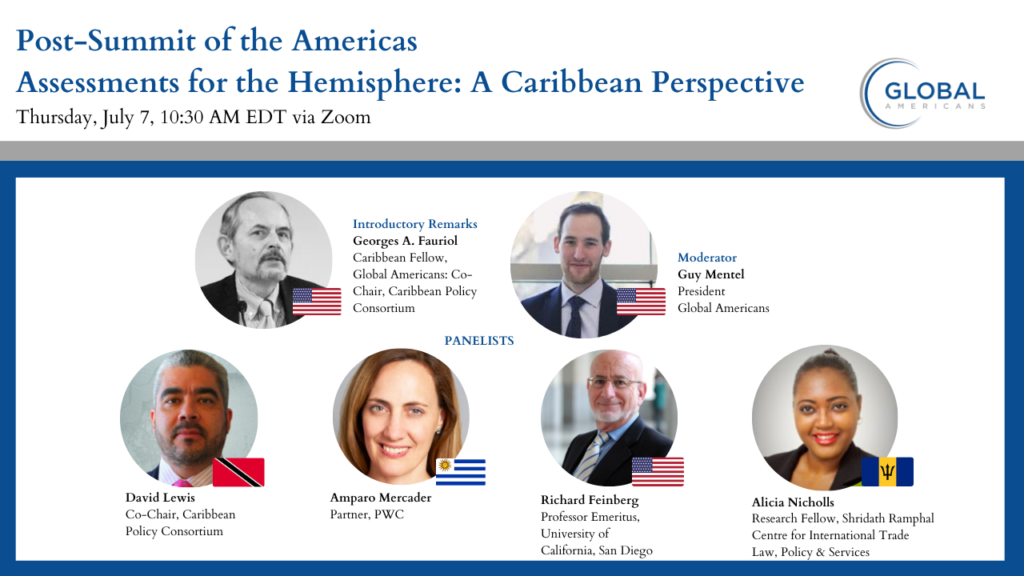
Post-Summit of the Americas Assessments for the Hemisphere: A Caribbean Perspective

Date: Thursday, July 7, 2022

Time: 10:30 am EDT

The Global Americans and the Caribbean Policy Consortium hosted a conversation with Georges Fauriol, David Lewis, Amparo Mercader, Richard Feinber, and Alicia Nicholls. Panelists assessed the IX Summit of the Americas from a regional perspective and compared this summit to summits past. Georges A. Fauriol offered opening remarks, and Guy Mentel moderated the conversation. See full video below.

Summary

Georges Fauriol began the event with an opening presentation, summarizing the outcomes of the Summit of the Americas, held last month in Los Angeles. Even before the summit took place, it had already generated controversy among regional leaders due to the exclusion of Cuba, Nicaragua, and Venezuela. Several of the initiatives launched at the summit—including the Americas Partnership for Prosperity, the U.S.-Caribbean Partnership to Address the Climate Crisis 2030, and the Los Angeles Declaration on Migration and Protection—risk becoming little more than “policy by pronouncement” unless countries follow up with proper implementation.

Following Fauriol’s comments, Guy Mentel moderated a discussion among the panelists. The conversation covered climate change mitigation and adaptation, trade and investment, nearshoring, regional integration, immigration, energy, and the crisis in Haiti, among other topics.

Panelists

  • Guy Mentel – President, Global Americans
  • Georges Fauriol – Global Americans Caribbean Fellow and Co-Chair, Caribbean Policy Consortium
  • David Lewis – Co-Chair, Caribbean Policy consortium
  • Amparo Mercader -Partner, PwC
  • Richard Feinberg -Professor Emeritus, UC San Diego and Member of the Global Americans International Advisory Council
  • Alicia Nicholls -Research Fellows, Shridath Ramphal Centre for International Trade Law, Policy, & Services

Quotes

Georges Fauriol: “Often the side-shows at summits (between varying actors like NGOs and the private sector) are quite positive for building consensus. Particularly for the Caribbean at this summit, on food and energy security.”

Georges Fauriol: “[The IX Summit of the Americas] furthered a U.S. tendency of instituting policy by pronouncement.”

Alicia Nicholls: “[The fact that] Cuba is one of the largest sources of immigration to the U.S. provides some context as to why some Caribbean governments insisted on Cuba’s inclusion at the summit.”

David Lewis: “[For Southern Caribbean countries,] climate change is an endemic, existential threat, but that these countries need income, jobs, and opportunities today. Those needs must feature in any diplomatic discussion.”

Richard Feinberg: “[At the first Summit of the Americas in 1994,] Argentina led the call for the [Free Trade Area of the Americas], Brazil championed democracy promotion, and Honduras and Venezuela put forward proposals on corruption. How have things changed since.”

Richard Feinberg: “I give points to the administration for not focusing on China. It was never explicitly brought up, and they deserve credit on that.”

Amparo Mercader: “If the U.S. cannot agree on [a free trade agreement]; customs agreements, services promotion, and double-taxation agreements would be welcome compromises.”

Amparo Mercader: “Nearshoring is as much a political as a business move. It builds resilience and diversifies resources, just in case. Many U.S. companies are diversifying resources away from China, but instead of relocating to the hemisphere, [they’re moving] mostly to other Asian countries.”

Read Richard Feinberg’s article in Global Americans: IX Summit of the Americas: Creative Diplomacy for a Fractured World.

Read Guy Mentel and Jackson Mihm’s article in Global Americans: The U.S.-Caribbean Partnership to Address the Climate Crisis 2030: A Timely Initiative Worthy of Serious Investment.

Learn more about the Global Americans High-Level Working Group on Climate Change in the Caribbean: https://theglobalamericans.org/climate-change-caribbean/.

Latest Webinars

Celebrating Caribbean Americans: What role can they play in advancing US-Caribbean ties?

In celebration of Caribbean American Heritage Month, the Caribbean Initiative and the Caribbean Policy Consortium hosted a public, virtual discussion on how the Caribbean diaspora can strengthen US-Caribbean relations and advance newly announced commitments from the Summit of the Americas.

Caribbean Americans are the natural expression of a fruitful US-Caribbean partnership, often playing a major role in US society, politics, culture, and the economy. Seven of ten Caribbean migrants live in the United States, with much of the diaspora concentrated in Florida, New York, and Texas. As new challenges emerge in the Caribbean, diaspora voices, influences, and perspectives are needed and can help shape US-Caribbean policy as we look to build on ties advanced at the Summit of the Americas.

What additional opportunities exist for the US-based Caribbean diaspora to shape US political, economic, and security policy to the region? How can US officials connect with these diverse communities to translate Summit commitments into tangible action? And what can US government and business leaders learn from diaspora communities to strengthen the US-Caribbean partnership?

Speakers

H.E. Audrey P. Marks
Ambassador to the United States
Permanent Representative to the OAS

Jamaica

Terrence Blackman
Associate Professor, Medgar Evers College
City University of New York

Claire Nelson
Founder and President
Institute of Caribbean Studies

David Lewis
Vice President
Manchester Trade Ltd
Co-Founder Caribbean Policy Consortium

Melanie Chen
Board Member
Atlantic Council

Jason Marczak
Senior Director, Adrienne Arsht Latin America Center
Atlantic Council

Latest Webinars

Transforming Guyana, Episode I: Guyana and her Diaspora

Recorded: June 8, 2022

Summary

The Guyana Business Journal (GBJ) and the Caribbean Policy Consortium (CPC), on June 08, 2022, at 10:30 EST, has launched a series of Monthly Webinars entitled “Transforming Guyana.”

GBJ & CPC will:

(i) Bring together experts and prominent voices from Guyana, the diaspora, and around the world to discuss the impacts of Guyana’s oil and gas development;

(ii) Offer a nuanced look at the opportunities and potential pitfalls ahead for Guyana;

(iii) Explore strategies to maximize the positive impacts of the oil revenues on Guyana’s people and her future while mitigating the risks that other countries have faced; and

(iv) Identify the most promising roles the Diaspora can play in this transformation.

Episode 1 discusses promoting and encouraging a more profound and mutually beneficial relationship between Guyana and the Diaspora in its energy and economic diversification and economic development journey.

Panelists

 Mr. Arthur Deakin, Arthur’s expertise spans a wide range of energy segments, including solar, wind, oil, biofuels, biomass, LPG, LNG, energy storage/batteries, hydrogen, hydropower, and more.

Dr. Vibert Cambridge, Professor at Ohio University, School of Media Arts and Studies

 Dr. Lear Matthews, Professor, Department of Community and Human Services, State University of New York, Empire State College, and former lecturer at the University of Guyana, Faculty of Social Science

Ms. Rosalinda Rasul, Head of the Diaspora and Remigration Unit within the Ministry of Foreign Affairs and International Cooperation

Latest Webinars

U.S.-CARICOM TRADE AND INVESTMENT RELATIONS

Summary

In a global economy struggling to recover from the Covid-19 pandemic, contending with climate change, and being haunted by the return of rough and tumble geopolitical risk, U.S.-Caribbean relations are in the process of re-alignment. In many regards, the old business order has been turned on its head and new opportunities and risks are emerging for U.S. and Caribbean companies. Indeed, there is a greater sense that the business landscape is changing and from the creative side there is a sense of energy about opportunities. Nearshoring has returned as a powerful force in this, touching upon everything from Business Process Outsourcing (BPO) and captive insurance to the development of creative and orange economy and blue economy business activities.

Full paper by Dr. Scott B MacDonald can be accessed here

Presenter:

Dr. Scott MacDonald
Chief Economist, Smith’s Research & Gradings

Discussants:

Mr. Steven Whittingham
Deputy Chief Executive Officer, GraceKennedy Financial Group

Mr. Anthony Ali
Chief Executive Officer, Goddard Enterprises Limited

Dr. Damie Sinanan
Manager, Competitiveness and Export Promotion, Caribbean Export Development Agency

Moderator:

Dr. Jan Yves Remy
Director, Shridath Ramphal Center for International Trade Law Policy and Services, U.W.I Cave Hill Campus

Latest Webinars

Climate Change Mitigation & Adaptation in the Caribbean

This webinar is part of the LACC/CPC Caribbean Policy Series.

Summary

Climate change and global warming are challenges that place the future resources, development, and prosperity of the Caribbean region in jeopardy. Specific hazards such as rising sea levels, warming temperatures, deforestation, ecological degradation, and more frequent and extreme weather events, among others, place the Caribbean at higher risk, to the point of coastal communities and entire islands potentially disappearing if the dangers of global warming are not addressed collectively and urgently today.

Caribbean nations (islands and coastal territories) share similar infrastructure, economic and human mobility risks to climate change, while also facing other challenges such as low availability of resources, high debt rates, threats to and relocation of coastal populations, weak conservation and environmental protection policies and institutions, and dependence on imports, fossil fuels, tourism and global markets. All these highlight the need and urgency to adopt collective measures to combat, adapt to and prevent further damage by climate change at a faster pace.

Full paper by Dr. Legena Henry can be accessed here

Presenter

Legena Henry, PhD Lecturer, Renewable Energy, University of the West Indies, Cave Hill, Barbados

Panelist

Ligia Collado-Vides, PhD Professor and Associate Chair, Department of Biological Sciences, Florida International University

Andrea Lewis, MSc Senior Project Officer, Office of Institutional Planning and Infrastructural Services, University of the West Indies, Cave Hill, Barbados

Moderator

Lorraine Sobers, PhD Lecturer, Department of Chemical Engineering, Petroleum Studies Unit, University of the West Indies, St. Augustine, Trinidad and Tobago

Latest Webinars

LORRAINE SOBERS

Economic Outlook and Adjustments in a Pandemic Caribbean

This webinar is part of the LACC/CPC Caribbean Policy Series. Co-sponsored by the Caribbean Policy Consortium.

Summary

The COVID-19 pandemic has spawned 2 years of unparalleled economic strain, stress and decline like never before for the economies of the Caribbean. Unprecedented shocks to key sectors such as tourism and resource exports have resulted in some of the largest declines in growth ever recorded for the region.

This webinar brings together leading regional and international economic, business and health experts to discuss the current economic outlook and adjustments facing the region in 2022 and the prospects for economic stabilization and growth.

Presenter

Henry Mooney, PhD

Economics Advisor, Caribbean Department,

Inter-American Development Bank (IADB)

Presentation by Dr. Henry Mooney

Panelists

Ian Durant, MSc Director, Economics Department, Caribbean Development Bank (CDB), Barbados

Joy St. John, PhD Executive Director, The Caribbean Public Health Agency (CARPHA), Trinidad and Tobago

Alejandro Arrieta, PhD Associate Professor, Interim Chair, Department of Health Policy and Management

Robert Stempel College of Public Health and Social Work, FIU and LACC Affiliated Faculty

Moderator

David E. Lewis, PhD Co-Chair, Caribbean Policy Consortium and Vice President, Manchester Trade

Latest Webinars

The Fight Against Illicit Trafficking of Firearms in Latin America and the Caribbean

Organized by the ABA Criminal Justice Section’s International Committee in cooperation with the Caribbean Policy Consortium (CPC)

Summary

This webinar will discuss efforts to combat illicit trafficking of firearms in Latin America and the Caribbean, focusing on the Inter-American Convention against the Illicit Manufacture of and Trafficking in Firearms, Ammunition, Explosives, and Other Related Materials (CIFTA), the Protocol against the IllicitManufacturing and Trafficking in Firearms, Their Parts and Components and Ammunition (Firearms Protocol), and other treaties with respect to the trafficking of firearms. 

It will also discuss the lawsuit pending in U.S. District Court in Massachusetts (Mexico v. Smith & Wesson) brought by the Mexican Ministry of Foreign Affairs against firearm manufacturers and distributors.

Panelists

Alejandro Celorio Alcántara, Legal Adviser, Ministry of Foreign Affairs of Mexico
Pier Angelli De Luca, Specialist of the Department of Public Security, Organization of American States

Simonetta Grassi, UNTOC’s Firearms Protocol Secretariat, UN Office on Drugs and Crime
-Sheridon Hill, Public Information Officer of the Trinidad and Tobago Police Service and formerly with OAS Inter-American Committee against Terrorism

Moderator

Bruce Zagaris, Berliner Corcoran & Rowe LLP; Fellow, Caribbean Policy Consortium


Latest Webinars