Recent Articles
Rosaria, Alex David. 2025. “Curaçao Picks a New Parliament: What You Need to Know.” March 18, 2025. https://alexdavidrosaria.wordpress.com/2025/03/18/curacao-picks-a-new-parliament-what-you-need-to-know/.
Recent Articles
Rosaria, Alex David. 2025. “Curaçao Picks a New Parliament: What You Need to Know.” March 18, 2025. https://alexdavidrosaria.wordpress.com/2025/03/18/curacao-picks-a-new-parliament-what-you-need-to-know/.

Date & Time
Feb 19, 2025 10:00-11:30 AM EST
Description
Panel discussion organized by LACC and the Caribbean Policy Consortium for the 2025 Webinar Series. The first webinar will discuss the Crime Conundrum, an overall status assessment, using the CARICOM crime symposium held in Georgetown last December 2024 as data input as well as some Mental Health Aspects of the Crime Conundrum.
Background
Crime and violence continue to wreak havoc on Caribbean societies, demonstrating the dangerous mixture of guns and gangs in several places, and impacting safety and security in a variety of ways. Quite understandably, the upsurge in homicides in recent year in many nations, which necessitated declarations of States of Emergency in Jamaica, Haiti, and, most recently in Trinidad and Tobago, highlights the law enforcement and national security aspects of the conundrum. However, there are serious public health and other implications, which warrant attention. This webinar pays attention to crucial public health aspects.
PANELISTS:
Mr. Callixtus Joseph
Acting Assistant Director of Policy, Strategy, and Innovation at the Caribbean Community Implementation Agency for Crime and Security (CARICOM IMPACS)
Dr. Elizabeth Ward
Professor of Practice in Violence and Injury Prevention, University of the
West Indies, Mona, Jamaica
Mr. Hance Richards
St. Kitts and Nevis Defence Force Special Reserves Sargeant and doctoral candidate, Texila American University
MODERATORS:
Dr. Ivelaw Lloyd Griffith
Founding Fellow, Caribbean Policy Consortium and Senior Associate.
Center for Strategic and International Studies
Dr. Anthony Pereira
Director, Kimberly Green Latin American and Caribbean Center at Florida International University

UWI SRC/CPC Webinar on OECD’s BEPS Pillar 2 and Tax Implications in the Caribbean
Wednesday, February 12, 2025 @ 1pmEST
Join us for a free and insightful webinar, co-hosted by the Caribbean Policy Consortium (CPC) and the Shridath Ramphal Centre (SRC) of The University of the West Indies, Cave Hill, where we will break down the OECD’s BEPS Pillar 2 and what it means for tax systems, global businesses, and the Caribbean region.
This timely event takes place via Zoom on February 12, 2025 at 1:00-2:30 pm (EST)/ 2:00-3:30 pm (Barbados time/AST)
Why You Should Attend:
1. Understand Pillar 2 and learn about its purpose, key features, and implementation in CARICOM countries.
2. Gain insights into how the Caribbean is responding to this global tax initiative.
3. Hear business perspectives and discover how multinational enterprises are adjusting their strategies and compliance practices.
4. Engage with experts and ask your questions, and gain actionable insights for your business or policy work.
This is a must-attend session for policymakers, business leaders, tax professionals, and anyone interested in global tax policy and what recent developments at the OECD and in the US mean for the Caribbean.
View webinar recording here:

SRC/CPC Lunch Time Chat on ‘Reshaping US-Caribbean Trade Relations: Trump 2.0 and Beyond’
Tuesday, February 4. 2025 @ 1pm EST
Join the Shridath Ramphal Centre of The University of the West Indies and the Caribbean Policy Consortium (CPC) on Tuesday, February 4, 2025 at 1:00-2:30 (EST)/ 2:00-3:30 (Barbados/AST) for our webinar entitled “Reshaping US-Caribbean Trade Relations: Trump 2.0 and Beyond”.
Our expert panelists will delve into the evolving dynamics of US-Caribbean relations during the Trump 2.0 era and beyond, and will explore the pathways for the region’s engagement with the US in a shifting geopolitical landscape. Participants will gain valuable insights into the implications of US trade and economic policies, the role of diplomacy, and the future of Caribbean-US partnerships in an increasingly complex global environment.
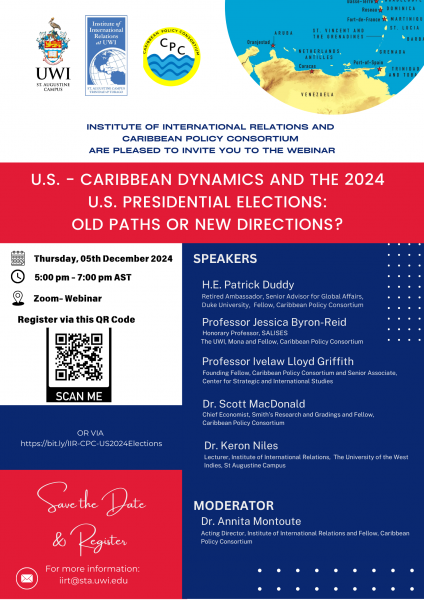
The Institute of International Relations (IIR) and the Caribbean Policy Consortium (CPC) hosted an engaging webinar on December 5, 2024, titled “U.S.-Caribbean Dynamics and the 2024 U.S. Presidential Elections: Old Path or New Directions.”
This insightful discussion explored the growing similarities in foreign policy approaches between Kamala Harris and Donald Trump, shedding light on the implications for the Caribbean and the global landscape beyond traditional party lines.
The recording is now available for those who missed it or wish to revisit the thought-provoking analysis.
Please see the flyer. attached and below. for more information.

Date: Wednesday, December 11, 2024
Time: 10:30 AM – 12:00 PM EST
Platform: StreamYard (Live-streamed on GBJ platforms)
About the Webinar
Join us to discuss Guyana’s transformative journey over the past decade.
This webinar will explore the country’s socio-economic evolution and its implications for the future.
View the Recording:
Key Themes:
The evolution of Guyana’s oil economy and its impact on GDP and national development.
Shifts in societal structures, economic inequality, and governance.
Opportunities for sustainable growth and diversification amidst rapid transformation.
Lessons learned from the past decade and strategies for the next.
Featured Speakers
Robert Persaud, Foreign Secretary, Ministry of Foreign Affairs and International Cooperation, Guyana.

Greg Quinn, OBE Former British High Commissioner to Guyana and Non-Resident Ambassador to Suriname (2015–2020).

Professor Paloma Mohammed Martin, Vice Chancellor of the University of Guyana (UG).

Register Now!
Secure your spot today and join this insightful conversation. Space is limited, so don’t wait!

PRESS RELEASE
The Guyana Business Journal and Caribbean Policy Consortium recently hosted a thought-provoking webinar titled “Powering the Future: Guyana’s Energy Landscape and the Gas-to-Energy (GtE) Project.” The event gathered experts: Anthony Bryan, Milton Chaves, David Goldwyn, and Ulric Trotz– from academia, industry, and policy circles to discuss Guyana’s emerging role as a regional leader in energy and sustainable development.
“Guyana is at a pivotal moment as it seeks to harness its newfound oil and gas wealth to drive sustainable economic growth,” said Dr. Terrence Blackman, co-host of the webinar. “The country faces both significant opportunities and challenges in managing this transition responsibly.”
Panelists
Anthony Bryan
Ulric Trotz
David Goldwyn
Milton Chaves
Moderators
Dr Terrence Blackman
Dr David Lewis
Key takeaways
Balancing Economic Growth and Environmental Sustainability
Guyana is committed to a holistic approach to developing its energy resources, aligning them with its low-carbon development strategy. Experts emphasized the importance of conducting thorough environmental and social impact assessments to mitigate risks associated with oil and gas operations, pipeline construction, and power generation infrastructure.
Diversifying the Energy Mix
While fossil fuels remain a key component, Guyana is advancing renewable energy projects, including solar, hydropower, and biomass. The country aims to generate 70% of its electricity from renewables by 2030, reducing its reliance on imported fuels and lowering carbon emissions.
Investing in Human Capital
Developing a skilled local workforce is essential for Guyana’s energy transformation. The webinar highlighted ongoing partnerships between Guyanese institutions and international organizations to expand training and education programs tailored to the energy sector’s evolving needs.
Gas-to-Energy Project: Enabling Development
Guyana’s Gas-to-Energy (GtE) Project, which will utilize associated gas from offshore oil production, is expected to double the country’s power generation capacity. This project promises a reliable, lower-cost electricity supply, making it a critical enabler for Guyana’s broader development goals.
“Guyana is well-positioned to become a regional energy and transition leader, leveraging its oil and gas resources to finance sustainable development while diversifying its energy mix,” said Dr. Blackman. “However, the country must navigate complex challenges to ensure that the benefits of its newfound wealth are equitably distributed and that environmental impacts are carefully managed.”
The Guyana Business Journal and Caribbean Policy Consortium are committed to continuing this essential dialogue through future webinars exploring innovation, technology, and other critical aspects of Guyana’s economic transformation.
The Guyana Business Journal (GBJ) and Caribbean Policy Consortium proudly launched Season III, Episode I of their Transforming Guyana Series focusing on “Vision 2040: Guyana’s National Development Plan.”
The webinar brought together a distinguished panel of experts to discuss Guyana’s future and the comprehensive integration of economic, environmental, and social strategies under the National Development Plan.
Participants explored the practical implications and benefits of implementing this plan across various sectors, emphasizing fostering active participation and collaboration among stakeholders.
Key Highlights:
Vision 2040: A discussion on the future vision for Guyana, integrating diverse strategies for sustainable national development.
Economic, Environmental, and Social Strategies: An in-depth look at how these strategies promote growth and resilience.
Practical Implications and Benefits: Exploration of the tangible impacts of the National Development Plan on various sectors.
Stakeholder Collaboration: Encouragement of active participation from policymakers, business leaders, environmental advocates, academics, and other stakeholders.
Interactive Q&A Session:
Participants engaged directly with panelists through an interactive Q&A session, making it a highly engaging and informative experience.
Panelists:
Dr. Vibert Cambridge
Dr. Ivelaw Griffith
Dr. Ulric Trotz
Dr. Lear Matthews
Moderators:
Dr. Terrence Blackman
Dr. David Lewis
The conversation emphasized the critical importance of a national development plan for Guyana’s growth and development. It focused on environmental challenges, leveraging the skills and resources of the Guyanese diaspora, and prioritizing climate resilience. Key points included addressing demographic changes, cultural landscape, and territorial security while tackling issues like poverty, crime, race, and cultural awareness. The potential contributions of the diaspora in community development, healthcare, education, and business were highlighted, along with the challenges they face, including resentment and discrimination.
Action Items Emerging:
1. Coastal Population Security: Implement comprehensive risk mapping and contingency planning for community relocation to secure Guyana’s coastal population.
2. National Development Plan: Develop a broad stakeholder consensus around a shared vision for Guyana’s future.
3. Support Iwokrama: Increase funding for Iwokrama as a leading institution for forest management, carbon credits, and indigenous relations.
4. Diaspora Engagement Strategy: Design a holistic engagement strategy and establish structured mechanisms for diaspora contributions.
This webinar is an essential resource for anyone interested in Guyana’s economic future. It serves as a valuable case study for similar economies looking to learn from Guyana’s approach to national development
The transitional governance structure agreed to in mid-April through the mediation efforts of Caricom and direct support from the United States faces profound challenges, but at minimum provides a baseline framework that Haitian political and civil society actors can build from — and that the international community, notably the US, can provide targeted support for. What are the mid to longer term prospects for the Presidential Council governance agreement to meet its goal of transitioning to an elected government by February 2026?